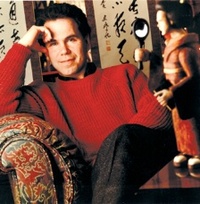
About the Author: Memoirs of a Geisha, published in 1997, is Arthur Golden's debut novel. The bestselling novel was a long time in the making; Golden spent more than ten years on the novel, throwing out the first two drafts before finding his "voice" in the first-person account that was a publishing success. Golden was born in 1957 in Chattanooga, Tennessee, to a family of journalists. His parents, Ben and Ruth, published the Chattanooga Times, and in the early 2000s his cousin, Arthur Ochs Sulzberger, published the New York Times. Golden's parents divorced when he was eight, and his father died five years later. Golden relates this to his challenges with the Chairman's character as Sayuri's love interest. Because his father was absent for much of his childhood, Golden struggled to make the character and the relationship believable because he had not personally expirenced what he was writing about. He struggled to make the story his own, yet found a way to incorporate his own life into the life of Sayuri.
|  |
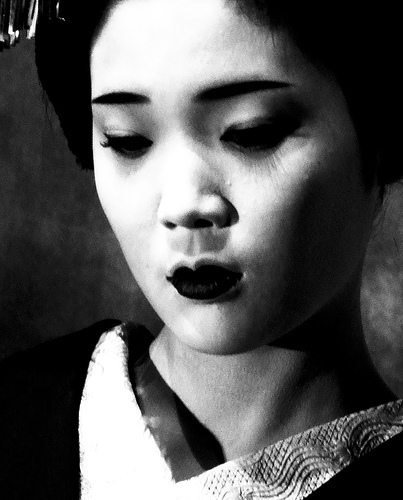  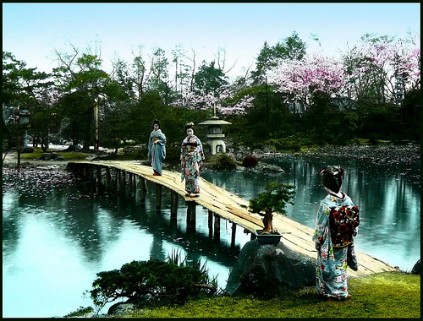 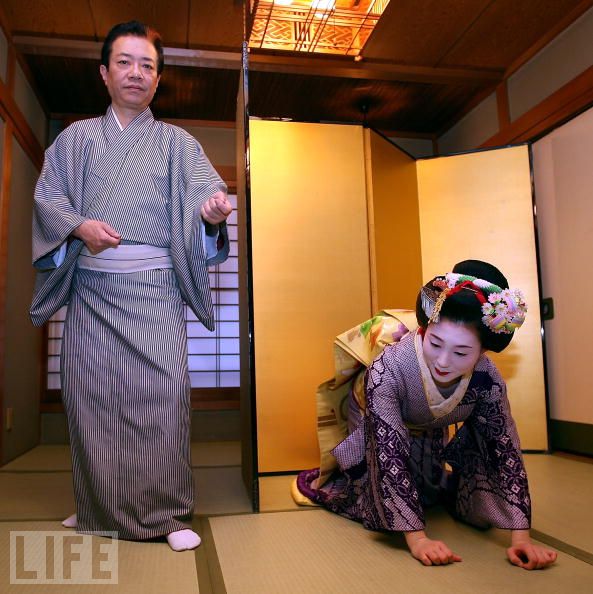 | Life of a Geisha and History of Kyoto The geisha and her world continue to fascinate people around the world as part of their image of a mysterious and timeless Japan. Prostitution is of course referred to as the "oldest profession," and the history of the geisha stretches back several centuries. But while many people assume that geisha is just a Japanese word for a prostitute, the somewhat more romantic word 'courtesan' is probably closer in nuance, though even that is misleading when you consider their history. The word geisha itself literally means 'person of the arts' - indeed the earliest geisha were men - and it is as performers of dance, music and poetry that they actually spend most of their working time. The two most famous hanamichi (geisha quarters) can be found in the capital cities of today and yesteryear, Tokyo and Kyoto. Medieval Edo, as Tokyo was formerly known, had the Yoshiwara pleasure quarters, where kabuki actors and artists would mingle with the evolving merchant class. The Edo period (1600-1868) was a time when Japan was largely closed to the outside world and also an era of great cultural development. Actors, sumo wrestlers and geisha were often the subjects of colorful ukiyo-e, woodblock prints whose name literally means 'pictures of the floating world,' a wonderful euphemism for the world of carnal desires. In the case of Kyoto, entertainment was to be found in the Shimabara district. Even today, geiko, as they are referred to in Kyoto, and maiko entertain customers in traditional teahouses. http://www.japan-zone.com/culture/geisha.shtml
Japanese Society
In Japanese society the men were taught that honor was everything. Life was literally not worth living without honor, and honor for the military man was found in dying a glorious death for the Emperor, as stated by John A. Lynn in his work Battle. Iris Chang in her book The Rape of Nanking, relates howJapanese women, in turn, were expected to remain pure and faithful, the women themselves kept out of public view in a society which praised the masculine, and which was dominated by the same. These ideas and beliefs surrounding divine rights and racial purity, coupled with a rigid structure for the behavior of both men and women in Japanese culture, set the stage for brutal confrontations with other cultures. The Japanese, as recorded in The War in American Culture, sought to establish what they saw as a natural position of dominance over the rest of the Asian world. By being the dominant race the Japanese saw no issue with teaching their concept of racial supremacy to their children in order to prepare for war, and Chang states that it is this theory which would allow the Japanese to rationalize the committing of atrocities upon both soldiers and civilians in occupied territories. This idea of dominance and racial purity would grow stronger, and more terrifying, as the war effort expanded first into China and then into the Pacific.
|
